
ISO 9001:2015 Certified Company
Industrial Surface Preparation Services to SA 2½ Standards
Abrasive Blasting for Reliable Coating Adhesion and Corrosion Control
- Achieves SA 2½ cleanliness for coating reliability
- Enhances adhesion of metallizing and paint systems
- Removes contaminants and surface defects
- Improves corrosion resistance and service life
- Suitable for large and complex steel structures
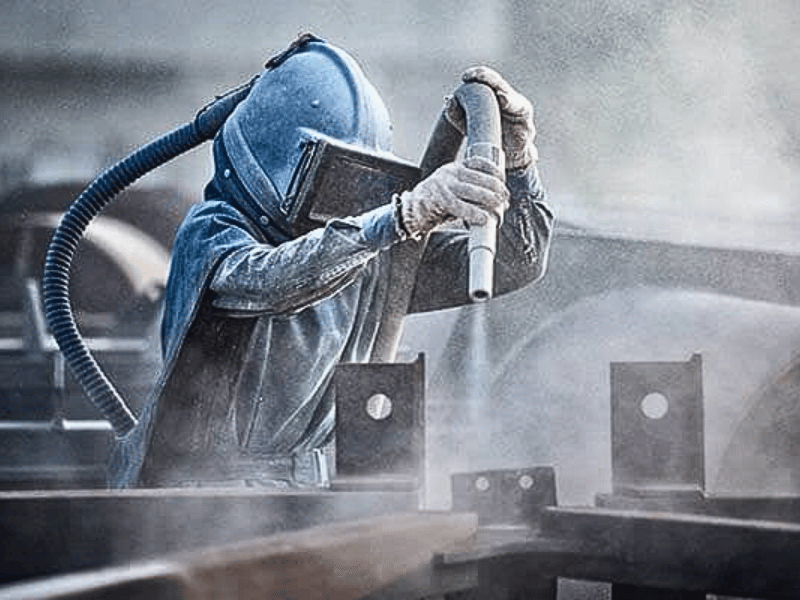
Quartz Blasting
Aditya Metallizing Services provides technically controlled industrial surface preparation services that form the foundation of effective corrosion protection systems. Proper surface preparation is critical to achieving durable adhesion of metallized coatings and paint systems, particularly for components exposed to aggressive industrial and marine environments.
Surface preparation is primarily carried out through abrasive blasting using copper slag, grit, or quartz abrasives. The blasting process is executed to achieve Swedish Standard SA 2½ cleanliness in accordance with SSPC-SP10 and ISO 8501-1. This level of preparation removes mill scale, rust, welding slag, and contaminants, resulting in a clean, metallic surface with a uniform profile suitable for coating application
Prior to blasting, all sharp edges, weld spatters, and surface irregularities are mechanically cleaned. Oil, grease, and other contaminants are removed using approved solvents to prevent coating failure. Blasting parameters such as nozzle size, angle, distance, air pressure, and abrasive grade are carefully controlled to achieve consistent surface roughness without damaging the substrate.

Copper Slag Blasting

Grit Blasting
Aditya Metallizing Services utilizes venturi-type blasting nozzles with tungsten carbide or boron carbide liners to maintain consistent abrasive velocity and cleaning efficiency. Oil-free compressors deliver stable air pressure, while moisture-free compressed air prevents flash rusting and surface contamination. Blasting operations are suspended when relative humidity exceeds acceptable limits, ensuring surface integrity is maintained.
Following blasting, surfaces are inspected visually and using blasting comparators to confirm SA 2½ compliance. Surface profile gauges are used to verify roughness parameters, ensuring compatibility with the specified coating system. Primer or metallizing application is carried out within four hours of blasting to prevent oxidation of the prepared surface.
These surface preparation services are essential for steel structures, tanks, ducts, exhaust systems, fabricated assemblies, and heavy engineering components across automotive, energy, marine, and infrastructure sectors.